
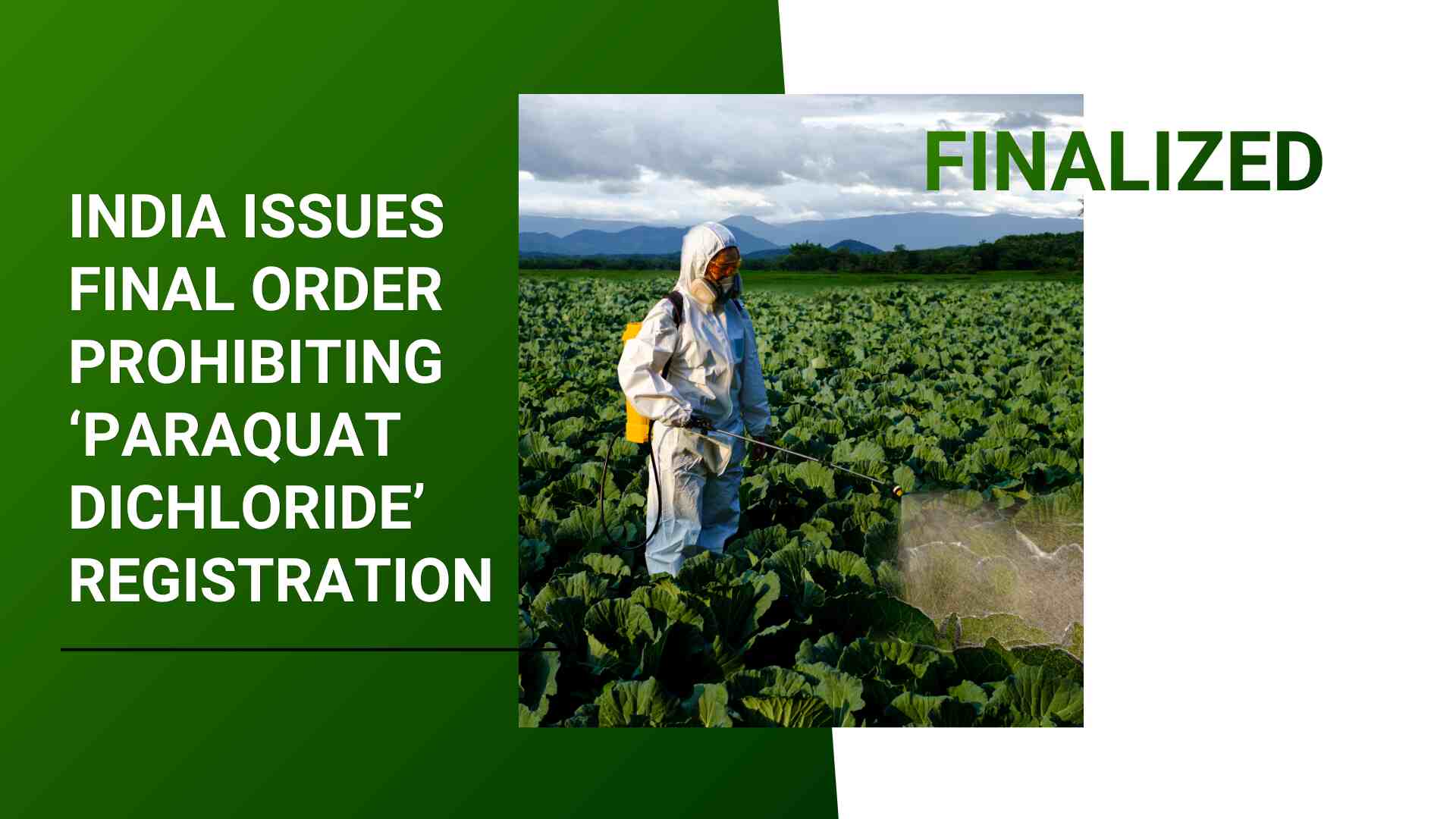
India Issues Final Order Prohibiting Paraquat Dichloride Registration
Following the release of the draft notification and the start of a 30-day public consultation process, Agroblast reported in July 2026 on the Government of India’s proposal to outlaw the production, import, transportation, distribution, sale, and use of paraquat dichloride. The suggested action has now...
Read More
New IZSC Harmonisation Document on DFR Study Evaluation to Apply from March 2027
New IZSC Harmonisation Document on DFR Study Evaluation: A new harmonization document on the evaluation of Dislodgeable Foliar Residue (DFR) research has been approved by the Interzonal Steering Committee (IZSC). The document, which was approved at the IZSC meeting on September 10, 2026, will be...
Read More
EU Adds Chlorpyrifos to the EU POPs Regulation
Requirements Apply from 30 September 2026 In order to update Regulation (EU) 2019/1021 on persistent organic pollutants (POPs) with respect to chlorpyrifos, the European Commission adopted Commission Delegated Regulation (EU) 2026/1423 of June 30, 2026. On September 10, 2026, the Regulation was published in the...
Read More
EU Adds 34 Hazardous Chemicals to Export and Import Controls Under PIC Regulation
EU Adds 34 Hazardous Chemicals to Export and Import Controls: Following an update to Annex I of the EU Prior Informed Consent (PIC) Regulation, businesses exporting specific hazardous chemicals from the EU will be subject to extra notification and consent obligations starting on October 1...
Read More
EPA Opens Glyphosate Public Comment Period Open Literature Search
EPA Opens Glyphosate Public Comment Period : In support of the continuing registration review of the popular herbicide, the U.S. Environmental Protection Agency (EPA) has made available an open literature search on glyphosate. The goal of the search is to provide information for an updated...
Read More
Why Regulatory Consultants Matter in the Age of AI
A recent occurrence in Anhui Province, China, demonstrates the risks of depending only on AI-generated pesticide recommendations. A 67-year-old farmer reportedly lost around 150 mu (about 24.7 acres) of sesame crop after implementing a pesticide regimen developed by an AI application. The farmer had apparently...
Read More
California DPR Announces Voluntary Cancellation of All Paraquat Products
A phase-out of paraquat use in California has begun, according to the California Department of Pesticide Regulation (DPR), which has stated that all producers of pesticide products containing paraquat-dichloride (paraquat) have voluntarily cancelled their product registrations in the state. In November 2024, DPR started reevaluating...
Read More
APVMA Introduces 90-Day Retention Period for Draft Applications in the Online Services Portal
APVMA 90-Day Retention Period for draft applications is a significant improvement to the Australian Pesticides and Veterinary Medicines Authority’s (APVMA) Online Services Portal. The new policy, which will go into effect on October 3, 2026, aims to improve data security, safeguard sensitive data, and guarantee...
Read More
Philippines Advances Fertilizer Regulatory Framework with Revised EUC Forms
Philippines Fertilizer EUC Forms 2026: In order to enhance the uniformity, openness, and effectiveness of fertilizer registration processes, the Philippines’ Fertilizer and Pesticide Authority (FPA) has released Memorandum Circular No. 04, Series of 2026, which introduces updated and new Experimental Use Clearance (EUC) forms. The...
Read More