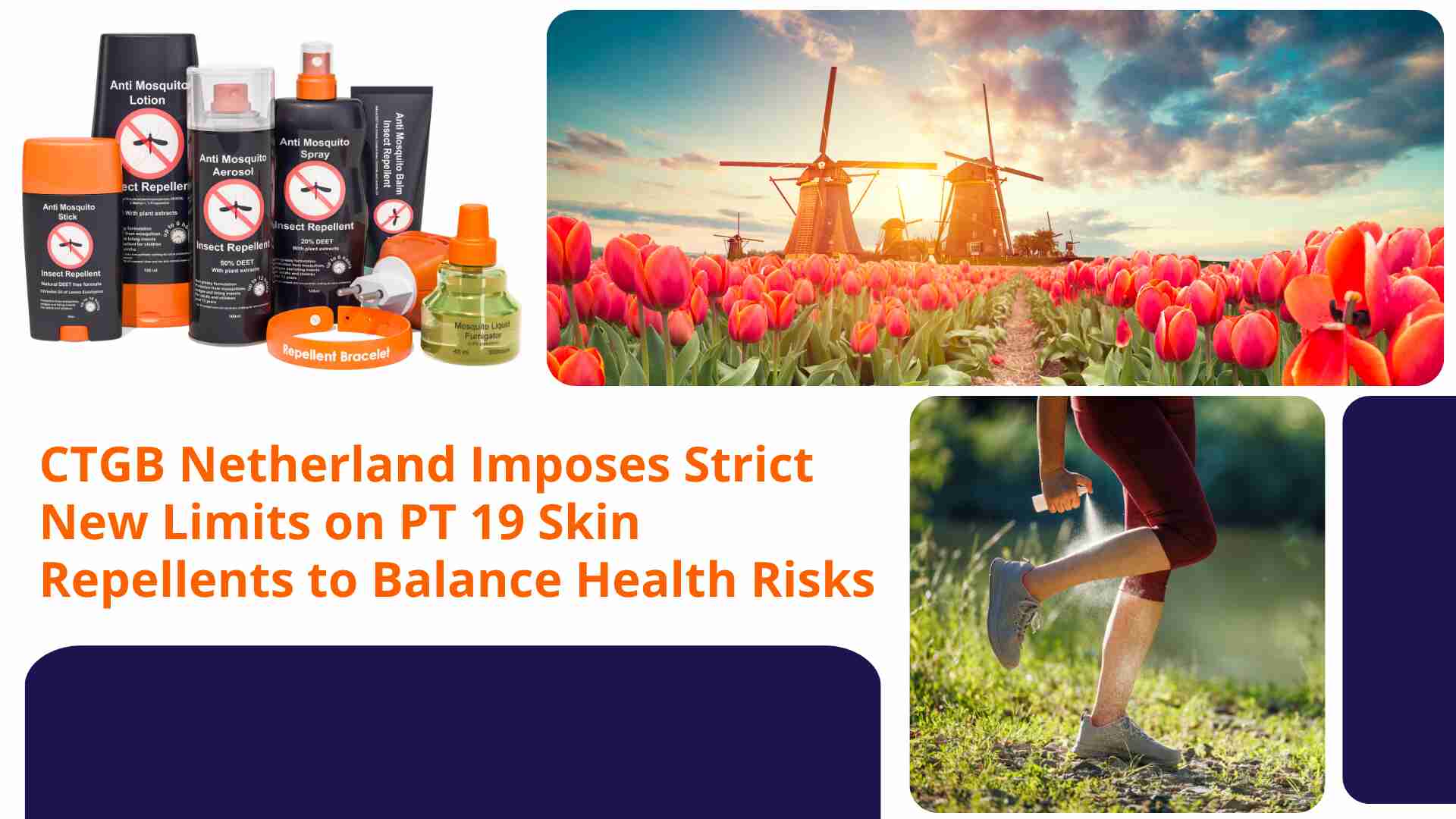
Stricter permission requirements have been issued by the Dutch Board for the permission of Plant Protection Products and Biocides (CTGB) for PT 19 repellents, which include lotions and sprays used on human skin to repel mosquitoes, ticks, and biting midges.
These updated regulations, which were decided upon at the Board’s February meeting, are applicable to all product authorizations, renewals, or amendments approved after April 30, 2026, regardless of the application’s initial submission date.
The Balancing Act: Public Health vs. Chemical Risk
Many well-known repellents made with DEET, Icaridin, and IR3535 regularly fail standard safety requirements (Article 19(1) of the Biocidal Products Regulation) because of intolerable hazards to human health and the environment, according to recent evaluations. However, the CTGB is using a regulatory exemption because it recognizes that these goods are essential to controlling vector-borne diseases, particularly given the growing threat of invasive mosquito species in the Netherlands. Instead, products that meet a demonstrable public need will be permitted under Article 19(5), but they will be subject to far stricter regulations to properly regulate exposure.
This is a temporary position depending on the state of the market. These Article 19(5) authorizations may be withdrawn if safer, fully compliant items are introduced to the Dutch market in the future.
Major Changes to Product Rules
The revised conditions introduce strict new limits to ensure market harmonization and safety:
Fixed Daily Application Limits: Adults and children two years of age and older are restricted to a maximum of two applications per day in order to reduce overall chemical exposure. Because there is a greater chance of unintentional oral exposure, children under the age of two are only allowed one application per day. To keep the playing field level, this rule is applicable everywhere.
A Limit on Chemical Concentration: The new regulations set a maximum allowable concentration of 30% active ingredient. To avoid unduly high environmental and health costs, products that exceed this limit will not be authorized. Products with more than 30% DEET are immediately impacted by this and are no longer permitted.
Zero Tolerance for Endocrine Disruptors: A product will be immediately denied authorization if it contains any co-formulant that has been found to have endocrine-disrupting effects.
New Labeling and Environmental Safeguards: Manufacturers are required to revise their instructions to incorporate a new environmental precaution, cautioning customers not to use the repellent right before taking a shower or swimming. Additionally, labels need to highlight non-chemical substitutes like bed nets and protective clothes.
Special Flexibilities for Tropical Travel
The CTGB points out that travellers may need more flexible usage patterns than conventional Dutch standards provide because tropical places pose far greater health concerns.
Product packaging will now be required to include a reference to the National Coordination Centre for Traveller Health Advice (LCR) in order to handle this securely. For people traveling to regions where harmful vector-borne diseases are common, the LCR will offer customized, adaptable advice on application frequencies and particular product selections.