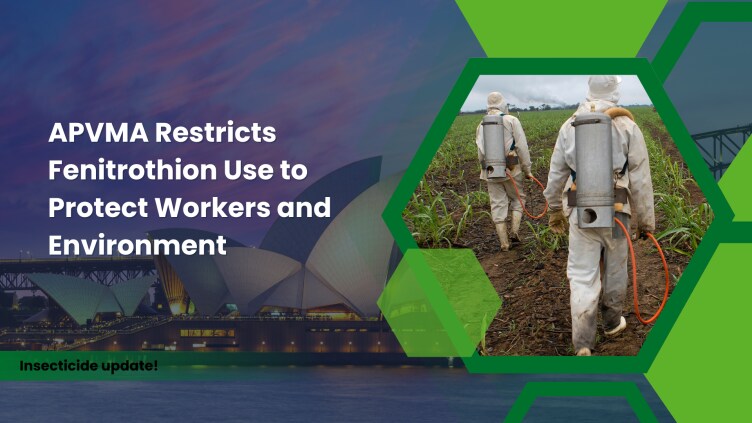
In the interest of worker safety, animal welfare, the environment, and commerce, the Australian Pesticides and Veterinary Medicines Authority (APVMA) has issued a final regulatory decision to place extensive new limits on the pesticide fenitrothion. Fenitrothion’s active ingredients, chemical products, and labeling have all been the focus of a chemical evaluation and public engagement.
The majority of the insecticide’s current applications in broad acre, pasture, horticulture, and the treatment of grain storage areas and poultry houses will no longer be permitted as a result of the APVMA’s final decision because it has concluded that there is no practical means of reducing the risks to the environment and worker safety.
What will change:
Most current uses of fenitrothion—like on large farms, pastures, in gardens, and for treating poultry houses—will be banned. Hand-held spraying will not be permitted for any use.
What is still allowed:
The pesticide can still be used on grain stored in silos.
Fenitrothion will only be permitted to be used under very specific conditions and under very stringent supervision after a 12-month phase-out period.
Fenitrothion’s safety margins will be strengthened by the revised usage guidelines and other restrictions, which will also take away permission to use the product in any way that compromises those margins.
In addition to the worker safety priority factors, the APVMA’s ultimate judgment was motivated by evidence of possible environmental harm associated with the great majority of applications. Due to spray drift, the environmental danger was mostly associated with birds, but it also affected small mammals and delicate aquatic species.
An insecticide called fenitrothion has been used to manage a variety of insects in pastures and agricultural crops, such as grasshoppers and plague locusts. Additionally, it has been utilized as a structural treatment in grain storage facilities, to combat litter beetles in chicken houses, and as a grain protectant to preserve cereal grains in storage for an extended period of time. There are substitutes for the majority of agricultural applications that will now be prohibited or limited.