

All biostimulant items supplied on the market must have a QR code written on their labels, per a directive from the Ministry of Agriculture and Farmers Welfare. A recent notification (No. 3-7/2025-Biostimulants (167640)) outlines this new step, which attempts to improve the product’s authenticity and transparency while making sure they adhere to the guidelines established […]
New EU Directive to Tackle Water Pollution! A temporary political agreement has been struck between the European Parliament and the Council president on a new regulation that would restructure the EU’s approach to water pollution management. In order to bring EU policy into line with the most recent scientific findings, the historic agreement modifies environmental […]

EU Commission Opens Public Consultation Until 2nd October 2025 New EU regulation on plant protection products that modifies the data requirements for active ingredients in plant protection products has been amended by the European Commission. In order to bring Commission Regulation (EU) No 283/2013 up to date with the latest scientific and technical developments, known […]

The revised guidelines for the Article 53 emergency authorisation procedure for plant protection products (PPPs) have been released, according to the Health and Safety Executive (HSE). As of right now, all upcoming applications must adhere to this new guidance. What is Emergency Authorization? A plant protection product (PPPs) may be temporarily put on the market […]

On March 1, 2026, the Health and Safety Executive (HSE) will implement revised guidelines for the technical, chemical, and physical characteristics of plant protection products (PPPs) in the Great Britain. This revised guideline, named the 2025 GB Physical, Chemical and Technical Properties guideline, is currently available on the HSE website for public scrutiny and will […]
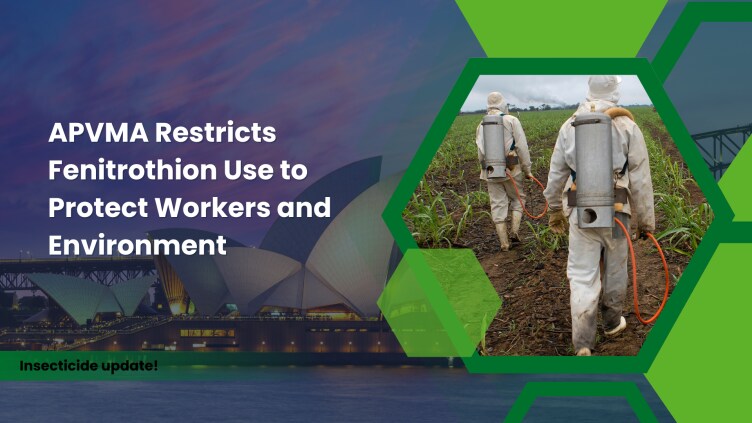
In the interest of worker safety, animal welfare, the environment, and commerce, the Australian Pesticides and Veterinary Medicines Authority (APVMA) has issued a final regulatory decision to place extensive new limits on the pesticide fenitrothion. Fenitrothion’s active ingredients, chemical products, and labeling have all been the focus of a chemical evaluation and public engagement. The […]

Numerous new biostimulant products have been approved by the Indian government, resulting in an abundance of innovations. The Ministry of Agriculture & Farmers Welfare has formally approved several products in a series of back-to-back FCO Amendments for Bio-Stimulants, which have greatly benefited farmers and the manufacturing sector. Recently, on August 13, 2025, the Gazette Notification […]
The Brazilian Health Regulatory Agency (Anvisa) has publicly declared that the 2022 ban on the pesticide active ingredient carbendazim was a successful and beneficial policy. Anvisa’s Collegiate Board accepted the Regulatory Result Assessment Report (ARR) of RDC 739/2022, prohibiting the use of carbendazim throughout the nation, at its recent 11th Public Meeting. The report’s findings […]

In a significant move to protect its citizens and the environment, Denmark has announced a national ban on the use of Per- and Polyfluoroalkyl Substances (PFAS) in clothing, footwear, and certain consumer impregnation agents. This proactive measure positions Denmark at the forefront of European efforts to eliminate these persistent “forever chemicals,” even as the European […]

The Ctgb (Board for the Authorisation of Plant Protection Products and Biocides) has issued a DROPLET model update, which evaluates whether active chemicals in plant protection products exceed drinking water standards (0.1 μg/L). Key updates in DROPLET 1.4.2: Corrected calculation mistake in version 1.3.2 for water and sediment transformation. DROPLET model update is compatible with […]